For the whole island lifespan
A civic building that serves only the working-age middle class in practice — even if it claims to welcome everyone — has failed at its civic mission. The Island Exchange is built, programmed, priced and governed to be genuinely useful from a 3-year-old at storytime to a 90-year-old at the memory café.
Why this matters here
- Guernsey is ageing. The over-65 population is rising sharply. A civic building only for working-age adults misses one of the largest underserved populations on the island.
- Loneliness is the most-cited social issue on the island for both older adults and teenagers. The same building can address both — but only if both are designed for from the start.
- The community feedback report on the Octopus site explicitly named "something for young people" as one of the strongest signals during early consultation. Older respondents said this too. The report's framing question — "Who is this place for on a wet Tuesday in February?" — is taken as the design test. More on the community brief →
Five generational groups, designed for separately
Lumping under-12s, teenagers, parents, retirees and the frail elderly into one "all ages welcome" category is the failure mode. We design for each separately.
Children under 12 (with parents)
Architecture: dedicated nook in The Half Moon with a low-walled buggy-park, child-height bench seating, and a window with full sea view. Family-friendly toilet on the ground floor with full changing facilities, accessible without going through any "private guest" zone. Robust, repairable play objects available on request — wooden puzzle, drawing supplies, picture books in English and Guernésiais, board games.
Programme: Free weekly Saturday-morning storytime in the reading room, run with the Guille-Allès Library. School-holiday programme. Family-rate menu with three nutritious meals at children's prices, available all day. Wet-weather welcome at no charge — staff trained that this is encouraged, not tolerated.
Teenagers (13–17)
The hardest demographic to serve well. Most "youth spaces" fail because they are designed by adults for teenagers without involving teenagers. Our commitment is structural, not decorative.
Architecture: the youth-keyholder zone — a defined area on Level 1 with its own entrance code, available during specified hours, where teens are not under direct adult supervision. Free WiFi, USB-C charging at every seat, a printer at cost. A small acoustic-isolated music practice room (a converted Recovery Room outside therapy hours) bookable in 90-minute slots.
Programme:
- Youth Council with real budget: 6–8 teenagers, recruited via the secondary schools, with £5,000 per year of programming budget they decide how to spend. Permanent advisory seat at the Critical Friends Panel.
- Music-friendly evenings every fortnight, programmed by the Youth Council — open mic, gig night, film screening, debate, video-game tournament. Adults welcome but the programme is theirs.
- Mentoring runs both ways: visiting trustees in the residency programme spend at least two hours with the Youth Council during their stay. The Youth Council in return delivers digital-skills sessions to older adults.
- Bursaried roles: paid Saturday-morning roles in the café reserved for teenagers from low-income households, paid at adult rate, treated as a real first job.
The youth programme is hard-coded into the surplus waterfall at minimum £25,000 per annum (Clause 3 of the constitutional clauses). It is preserved before any non-essential capital expenditure. If the project's commercial side struggles, the youth programme is preserved before café upgrades, before guest-suite refurbishment.
Working-age adults and parents (25–55)
Already partly served by the existing programme. The specific multigenerational additions:
- Childcare-friendly meeting rooms with a small adjacent area where a child can sit quietly with a book or drawing
- Breastfeeding-comfortable spaces in at least three locations, explicitly signalled as breastfeeding-welcome
- Family-rate civic room hire for christenings, birthdays, wakes, graduations
- Dedicated quiet-work hours (10:00–14:00 weekdays) in the reading room
Older adults (65–80)
The most reliable repeat-visit users of any well-designed civic building. Also the group most affected by social isolation. The programme is designed around their genuine needs.
- Friday morning film club — every Friday, 10:30 AM, a screening in the civic room (1950s–1990s classics in winter; documentaries in summer). Coffee and pastry included in the £4 ticket. Free for residents on means-tested support.
- Tuesday morning coffee group — a structured drop-in social hour (10:00–11:30) for older adults who would otherwise spend the morning alone. No agenda, just coffee, conversation, and a topic-of-the-week.
- Repair café — monthly Saturday morning event. Bring something broken; older adults with skills sit with younger adults and teach them how to fix it. Tools provided. Coffee included. Repairs free.
- Walking-and-talking group — weekly guided walk along the seafront from the Island Exchange to the Bathing Pools and back, at gentle pace, with seating points pre-identified.
- Talks programme — monthly talks from visiting trustees, local historians, scientists, artists. Free for over-65s on the island.
Pricing: 20% off all paid programming October to March for residents over 65 (Clause 2 of constitutional clauses). "Pay it forward" coffee fund — anonymous coffees for older residents on tight budgets.
Frail elderly (80+) and people living with dementia
The forgotten constituency in most civic projects, because they often cannot visit independently. The Island Exchange explicitly designs for them.
Architecture: Full step-free access from street to roof terrace. Lift sized for a wheelchair plus carer. Seating every 8 metres along any route. Wayfinding designed for cognitive accessibility. A quiet, low-stimulation room available on demand. Dementia-friendly auditing in Phase 1, working with the Alzheimer's Society Channel Islands.
Programme:
- Care-home outings programme: partnerships with three Guernsey care homes (named in Phase 0) for monthly group visits. The civic room is hired free for these visits. Tea, music and biscuits provided at no charge.
- Memory café: monthly Wednesday afternoon session for people living with dementia and their carers. Trained volunteer hosts. Music from the dementia-music repertoire (1940s–1970s). Free.
- Intergenerational music: termly visits from local primary school choirs to perform for visitors from the care homes. Reciprocal visits where care-home residents share stories and songs from their own youth with the children.
- Dignity-first toilets: at least two accessible toilets with assistance handles, full changing facilities for adults (not just babies), and adequate space for a carer.
Intergenerational mixing — the architectural principle
Designing for each group separately is necessary but not sufficient. The whole point of a multigenerational civic building is that the generations actually meet and learn from each other.
- The Tide Table at the heart of The Half Moon café is the architectural commitment — sized for groups of 12, with a long bench. People sit beside strangers at busy times. A child colouring next to a 75-year-old reading the paper next to a young couple sharing breakfast next to a teenager doing homework. The mixing is ambient, not forced.
- The reading room is shared across generations by hour: children's storytime Saturday morning, working-age quiet hours weekday late-morning, older adults' coffee group Tuesday morning, teen study area Tuesday-Thursday after school.
- The repair café is the strongest mixing event — older adults with skills, teenagers and young adults with broken objects, the mutual practical exchange that has nothing to do with charity and everything to do with usefulness.
- Making and showing art together. The Long Wall in the atrium is the principal exhibition — one local artist at a time, six-week shows, free to exhibit. The Tide Room beside it is the working studio: a roll-up shutter onto the atrium means residencies and school sessions happen in public, not behind closed doors. The Half Moon café picture rail carries lighter, smaller work, including school-age work for a fortnight at a time. Children watching a working artist; older adults exhibiting alongside teenagers; mess-tolerant making and finished showing visible from the same coffee table. The art programme is funded from the Civic Investment Vehicle, not commission, so local artists keep 100% of any sales. See the named spaces →
- The mentoring exchange between visiting trustees and the Youth Council, and between the Youth Council and older adults, is the most ambitious intergenerational claim and will require careful design and oversight in Phase 0–1.
Governance — who keeps this honest
Without enforcement, all of the above is good intention. The Critical Friends Panel includes a standing youth representative (rotating annually from the Youth Council), a standing representative for older island residents, and an annual accessibility/dementia-friendly audit by an external specialist. The annual public report includes specific multigenerational outcomes — children's sessions hosted, Youth Council programme spend, older-adult attendance, memory café and care-home outings figures.
Phase 0 will deliver: youth co-design workshops with at least 30 teenagers from across the island's secondary schools; older-adult engagement sessions with Age Concern Guernsey, the Hospice, and at least three care homes; dementia-friendly design review by the Alzheimer's Society Channel Islands; structured engagement with local primary schools.
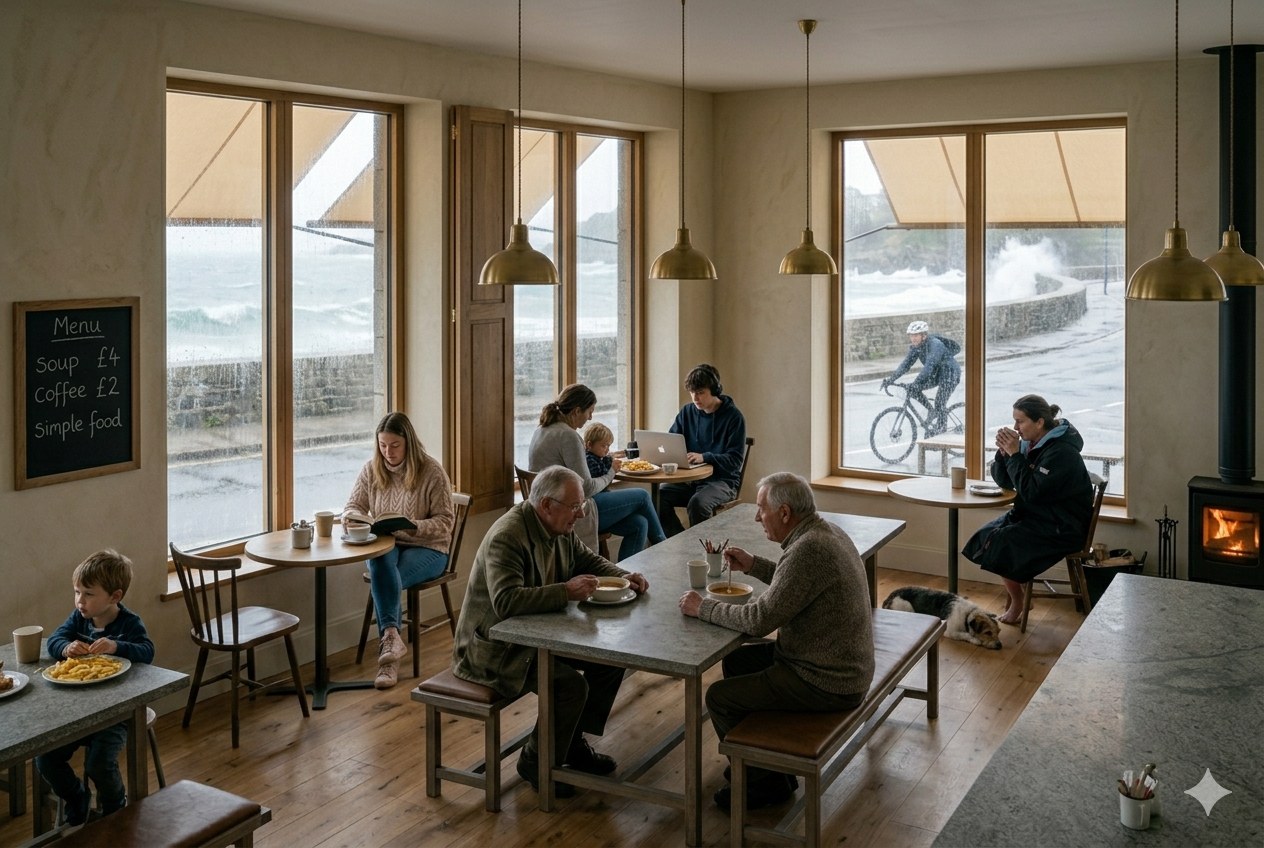
The test for this section
A 7-year-old asks her parent if they can go to The Half Moon on Saturday for storytime. She gets it.
A 16-year-old has nowhere else to be on a wet Tuesday in February. He has the youth zone.
A 75-year-old who has just lost his wife is shown to the Friday film club by a neighbour. He is welcomed by name on his second visit, and asked about his week on his third.
A 90-year-old with dementia visits with her care home group, hears the song her father used to sing, and her daughter sees her smile for the first time in months.
If all four of those things happen, the building has done what it is for. If they don't, nothing else matters.